
The SPF Scholarship
Ang Shermaine
23 December 2021
Special Task Squadron (Trainee), PCG, Singapore Police Force (SPF)
Year Awarded Scholarship: 2019
Undergraduate: Bachelor of Arts in History, University of Oxford, United Kingdom
Postgraduate:
Submitted in December 2021
As a female breaking boundaries in the SPF, I learned that my potential is defined not by gender or strength, but by my mental tenacity, a commitment to my team, and a deep dedication to serving the public.— Ang Shermaine
Title for the accordiWhy did you apply for the PSC’s scholarship and ultimately choose to accept it?on item
My Scholarship Application Journey, specific to the SPF
I was first interested in a career with the SPF when I attended a fireside chat with SPF officers held in my school. I had attended it with no prior expectations of joining, but the sincerity the officers showed when they shared why they chose to become a police officer really piqued my interest to learn more about the Police Force. I was then fortunate enough to attend the Aspiring Leaders Programme held by the SPF in June of my A-level year, where I got to learn and visit some of the units in the SPF to learn more about the variety of roles the police play in keeping us safe.
The way in which the officers candidly shared about their work, and the camaraderie they demonstrated during the programme gave me a glimpse of what working with the organisation could be like. I think the combination of these experiences led me to the decision to pick SPF as my first choice, as I was drawn to the meaningful and engaging nature of the job and the sincerity and down-to-earth nature of the officers I met.
I was initially apprehensive about joining, because of the requirements of having to take a leap of faith to enter Basic Military Training and Officer Cadet School in order to embark on a career in the Police Force. I was also slightly worried, given that no female candidate had been awarded this particular scholarship previously. However, I saw it as a challenge and something exciting to take on. I believed that it was not impossible for a female candidate to receive the scholarship, and the absence of any female recipients was more due to a lack of awareness about the requirements and possibility of applying. Additionally, I was convinced from the sharing by SPF officers who had been in service for a few years that this was a worthwhile and immensely meaningful career, and that the academic and military training requirements were attainable both physically and mentally.
How has being a PSC scholarship holder impacted your academic journey and/or professional experiences?
I benefited most from the process of getting the scholarship, as well as the attachment and internship opportunities that the scholarship offered.
The road to the scholarship
What I enjoyed most was the opportunity to go through and experience what all my male Singaporean friends had to go through and work alongside them during the tough times! In BMT, we were in an all-women’s platoon, but in OCS, I experienced what it was like to work in a male dominated environment and it was not as intimidating as I had expected (I was the only female in my platoon of about 30 people, and my wing of approx. 80 people only had 3 female cadets at the end of our 3 months of service term in OCS). I found that if I worked hard and was willing to hold myself to the same or higher standards than my male peers, they were quite willing to accept me as one of their own. I also learnt that my performance was not bound by my gender or my disparity in physical strength, but by my mental tenacity and “can-do” attitude.
Over time, I also learned the importance of being a team player, working together with my section and platoon mates who may think and work completely differently, and the importance of helping others even when I was exhausted or when I disagreed with them. I realised that it wasn’t my own strength, but the people around me, working alongside me, that got me through the most tiring outfields or trainings or problems. This was really a different environment from school where the focus was only on my own studies or the project groups’ work, which in terms of size, was very small compared to the groups I worked with in the military.
I grew tremendously observing and learning from the different leadership styles of my instructors and peers. Receiving feedback on how I was leading and the areas I needed to improve on was not always easy. But this was tough advice I needed to hear, and the opportunity to know more about myself under stress and how I could work on my responses and working style was a valuable experience.
I think what is amazing is that it isn’t where you start off at (whether mentally or physically) that matters most in determining if you will excel in training. Rather, it is how much you are willing to try and push yourself, even when it seems impossible and when the improvements are not always observable, as well as how much you are willing to sacrifice to work well and care for your team-mates that really determines who can push through.
Till now, the diversity of educational, familial and life backgrounds that these amazing individuals and leaders come from always reminds me that the best can come from anywhere, and that there is always something to learn from everyone you meet, no matter how different in background, experience, appearance, ability or gender they may be from you. In fact, it was this diversity that made us strong as a section, a platoon and most of all as a team. I am still learning to become more like these peers and seniors of mine, to be a bit more patient, caring, firm and determined in what I do. These 6 months also made me realise that I joined the SPF because I knew that there was much to learn from and contribute to such a diverse group of individuals, and that the same cause and duty could unite us all in our work.
Internship experiences
As an SPF scholarship holder, I had the opportunity to attend various attachments and internships over the summer vacation in my first and second year. I really appreciated the flexibility given which allowed me to request to be attached to more specialised units within the SPF.
I think the most memorable internships I had were the ones I had with the Exercise Readiness Division (Operations Department) and the Police Coast Guard (PCG). This was because I learned so much from the supervisors and colleagues I had worked with. Since my internship with PCG was most recent, I will share what I had learned from it.
Going into the internship, I had expected myself to learn about an interesting and seldom accessed specialist unit, and perhaps get a chance to see what sea patrol was like. These expectations were exceeded when I got to appreciate how unique and complex the maritime domain is from the planning stages to frontline patrol, handling contingencies to developing future operations capabilities like tethered drones or video analytics surveillance. From learning about the types of craft the PCG has, to sitting and experiencing the boats out at sea; getting familiar with maritime terminology to observing how officers are trained in highspeed or tactical manoeuvres: each aspect has been exhilarating and eye-opening! I never realised how much time and experience was needed for someone to become proficient at being a Coxswain or a Steersman, let alone a Crew Commander or Commanding Officer of a ship/boat. This was especially brought home when I saw how at night, the sea is just an expanse of darkness dotted with unfamiliar, hard to discern lights.
All in all, the scholarship opened doors to allowing me to learn through first-hand experience, and to better appreciate how various departments within my future workplace functions. It also allowed me to understand why it is very hard to bring in/replace expertise simply with fast-tracked personnel from outside because of the sheer amount of time and mileage required at the ground level. For these reasons, I hold so much more respect for those who choose to stay on with their experience and expertise to keep Singapore safe, especially in the uniformed organisations in Singapore.
Share with us some stories of your student life.
Like many others, I was hit by the pandemic and had only been in the UK for 2 terms before I ended up spending the next 4 terms in Singapore. However, it was a blessing in disguise, as it allowed me to take on more internships with my parent agency, and the chance to intern in the Operations Department and the Police Coast Guard. The scholarship really opened doors in terms of letting me experience and understand the less well-known aspects of policing through attachments and internships, and I think this really was a highlight of my 2 years of school, even though I could have been overseas instead.
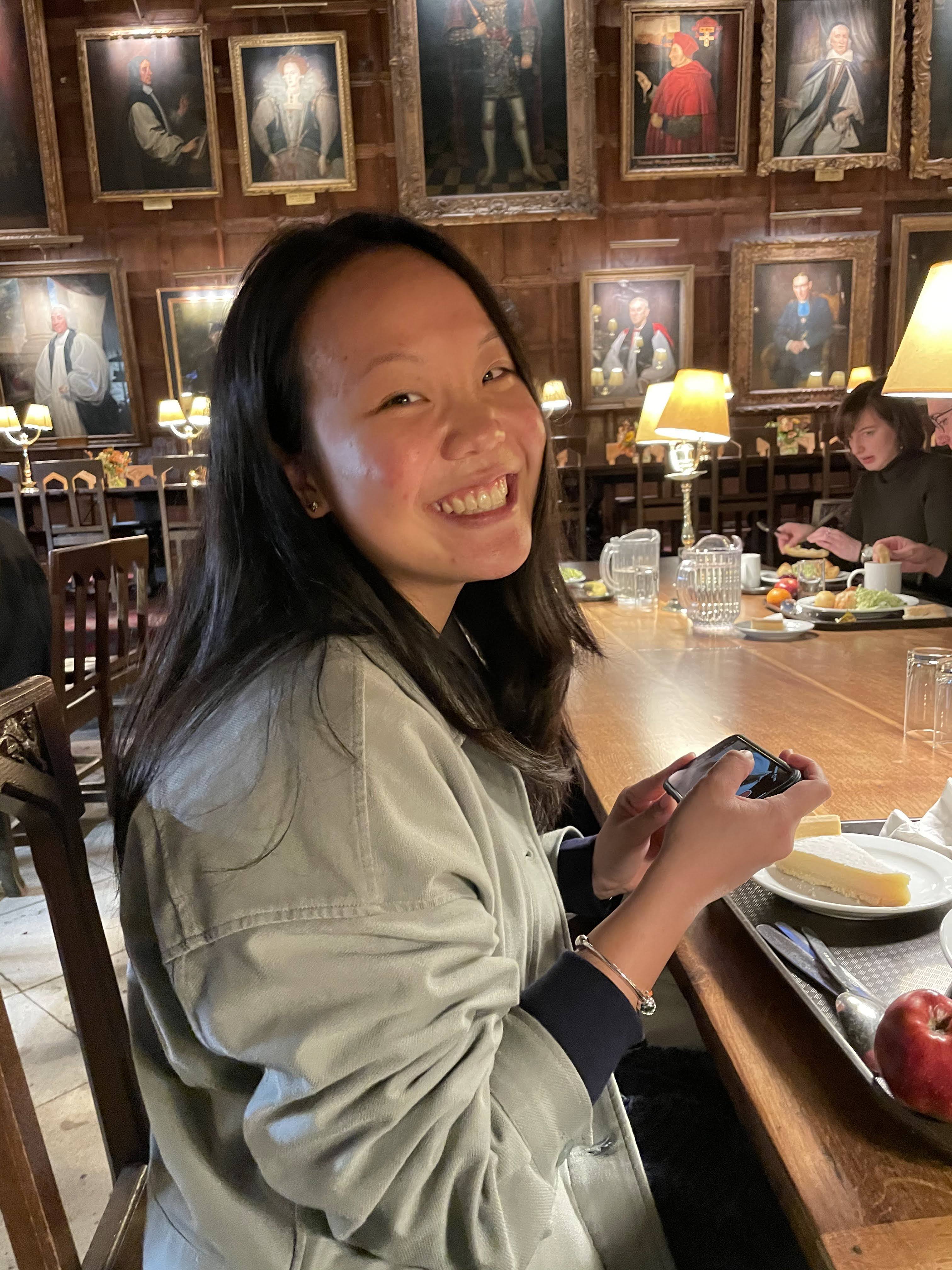
I returned to the UK for my final academic year in October 2021. While my time overseas ended up shorter than expected, I really value how I got to meet people from all countries and all walks of life, studying different degrees, speaking languages other than English, and holding within them such different perspectives all within my college! Living, working, and sharing meals together with different people in hall really opened my mind to the possibilities and opportunities available to us in the world, be it in the public or private sectors. With a diverse friend group, I really enjoyed trading stories and learning from my friends what various food would be called in the different languages, or how a certain issue or item we were discussing would be viewed differently in their area of discipline. Because everyone in my group of friends spoke a different language, an example of a fun dinnertime activity could be for everyone to say a random sentence like “a hot sheep walks across a bridge” in a different language, and then taking turns to try repeating it.
As a whole, I think learning from tutors who have a wealth of experience and insight, and having the chance to learn how to adapt to a new society and a new way of life, were the most challenging yet most rewarding aspects of studying abroad.
Are there any misconceptions about working in the Public Service and/or being a PSC scholarship holder that you have come to realise are not true?
I had the impression that things moved slower in the Public Service, in that there was plenty of bureaucracy and red tape that made innovation slower. To some extent, this may be true. However, once we bear in mind the need to remain accountable to the members of public we serve and use the funds we have wisely, such bureaucracy becomes essential safeguards to retain the trust and efficiency that our fellow Singaporeans expect from us.
If there is one word you could use to describe the Public Service, what would it be and why?
Dedication
If you could give one piece of advice to prospective PSC scholarship applicants and/or recipients, what would it be?
Always remember why you are choosing / chose to join the Public Service. Whether it is having a heart for serving others, wanting to bring about positive change, or other reasons, all of these may seem less appealing when you meet a diverse group of people pursuing different paths in life, or when times get tough. Despite all these, always remember to stay receptive to learning new perspectives. Being adaptable and nimble while retaining firm values is critical to being a good Public Service Leader and person in general.