Six outstanding candidates have been awarded the Lee Kuan Yew Scholarship this year for their postgraduate studies.
Chairman and members of the Public Service Commission,
Parents, teachers, principals and award winners.
1. A very good afternoon to all of you.
2. First, let me, on behalf of the government of Singapore and fellow Singaporeans, thank the Public Service Commission (PSC) for your 75 years of dedicated service. It is with your help that we have the Public Service that we are proud of today.
3. PSC has changed much over the years, as Tzu Yang mentioned. Over the years, our selection processes have changed. Our deployment frameworks have changed. Our development frameworks have changed. But there is one thing that will not change, and that is that we continue to depend on the good judgement of members of the PSC to select, develop, and deploy people to the best of their abilities in service of Singapore.
4. Today, many people will talk about Artificial Intelligence (AI) and are perhaps using AI for their selection systems. But for us, we will always believe that nothing can replace the judgement that the members of the PSC bring to bear on our selection process, and the rigour with which they use various tools to complement, but never to replace, their judgement. So, Tzu Yang and members of the PSC and the generations of people who have served on the PSC, let me thank you all for your service to our country. Thank you very much.
5. Every year when I come before you, I have to think very hard about what to share with you. This year is no different. But this year I must start off with a very unfortunate story that inspired my sharing this afternoon and, as usual, I will not share with you more than three points or three stories.
6. Let me start with a very unfortunate incident that inspired my thoughts for my sharing today. Some time back, a parent came up to me and said: “Minister, I have a very good son, and I would like him to volunteer with you.” I said: “Very good, thank you very much. Where would he like to serve? What are his passions?”
7. In front of some members of the public, it was very unfortunate that she said something along the lines of: “My son comes from a very good school. He's very talented. I hope you don't start him at the bottom, and I hope you will give him a good testimonial so that he can apply for the PSC scholarship.”
8. For those of you who still have any doubts, as the Minister-in-charge of the Public Service, I never write testimonials for people to apply for the PSC scholarship. That would be seen as a conflict of interest. I leave it to Tzu Yang and members of the PSC to assess whether someone is worthy of a PSC scholarship. So, if you want to serve with me, then you probably want to come with the goodness of your heart. Now, why did this little, unfortunate story inspire me to share three stories with you?
9. First story. Remember, as you walk the journey in the Public Service, you are not just there to find meaning. Beyond finding meaning, perhaps it's more important to give meaning to everything that you do.
10. Let me share with you about my first job in the Public Service in the Singapore Armed Forces (SAF). After my first year in university, I came back to be attached to a unit. I wasn't particularly very useful since I wasn't particularly trained. I was given the chance to go and shadow some platoon commanders to learn from them. I was feeling rather useless when everybody was rushing around doing many things to take care of the men and women under their charge.
11. I tried to make myself useful, and there was one particular task that was not particularly interesting for most people. I volunteered for that, and that was to throw rubbish on a Saturday afternoon. My camp was in Tanjong Gul, on the western side of Singapore. To throw rubbish, I had to take a three-tonne truck and bring the rubbish from Tanjong Gul camp after the men were dismissed, and bring it Lorong Halus on the eastern side of Singapore. I had to throw the rubbish and bring the truck back to the camp before I booked out in the evening at 6 o'clock. It was a job that nobody wanted to do because everybody was tired by Saturday. I thought that was the least I could do to help my unit. What did I learn from this? I learned many things from this.
12. Many years later, when I was the commanding officer, and when the audit came, and there were some allegations that some people might be misappropriating SAF property, I knew exactly where the problem was — because if you know how to throw rubbish, throwing rubbish can allow you to make quite a lot of money. Today, the lesson is not to teach you how to throw rubbish and make money. The lesson is to never look down on the smallest task that you are given. Do it with pride. Do it well. Not just because you are going to learn something, but because you show the rest of the world and the people whom you hope to command one day that you are prepared to do the smallest of tasks well, and you will never ask them to do anything that you won’t yourself do. First lesson: Do not just look for meaning, but try to give meaning to everything you do. In your journey in the Public Service, there will be moments where you are happy, and there will be moments where you are down. Regardless of whether times are good or times are tough, always remember to give meaning to what you do.
13. Second story. Once upon a time, there was a commander in a particular unit, and as commanders, we always like to have a say on the people who will join our command team. This particular commander had a very stringent requirement. He would only take the A graders. So indeed, he got many A and B graders. But guess what? He didn't always produce the best unit, and his team wasn't always the most cohesive, nor the top performing unit. What was the problem, and what was the mistake? The problem was this: he saw people as coming to his team just to perform, to achieve. But the real issue is, what is the higher purpose that he was trying to achieve? When he’s not around, would the team still perform?
14. My second message is this — when we go out and accomplish our tasks, let's remember this. Let's remember that when the job is done and we are around, that’s not the highest accomplishment. We need to build to last, and we have been taught that when we were young, that when you are no longer around, and the team continues to perform and even perform better than when you were around, then you have achieved something.
15. Success is not defined by our personal accomplishments in the Public Service. Success is defined by our contributions of how we uplift others in service of our nation. So remember, don't be like that commander to think that we only want to work with the very best. Our job is to see the best in everyone, to let everybody to be the best version of themselves, so that collectively, we can help Singapore defy the odds of history. And I'll come back to that later.
16. The third lesson that I've learnt is that we need to build networks — not just within the Public Service, but beyond. Because success in the Public Service is not just about how well we do within the Public Service, but how well we interface with the rest.
17. Once upon a time, I was quite a senior officer. I went to a foreign land, and I wanted to meet another senior officer. The senior officer rejected my meeting. Instead, he directed me to meet his junior staff. I was a colonel then. The junior staff was a lieutenant. How many of you would feel rather insulted when you request for a meeting with a senior officer and you are told to go and meet the junior staff? I didn't feel insulted. I took it upon myself and my team that this was another chance to engage someone whom, at that point in time, very few people were bothered with. We had good conversations. We stayed in contact. Many years later, strangely, he contacted me again. The then-junior officer now happens to be a Minister in his country.
18. My point is to never look down on people, especially people beyond Singapore. Never look at people based on their ranks or their appointments. Look at everyone as they are, value them, engage them, build relationships with them, as these will be the relationships that will put us in good stead as Singapore tries to navigate the challenges of the next few decades. We need to know people — we need to know people in depth, and we don't need to circumscribe ourselves to think that we only want to get involved and know people of a certain stature. Can we be a good testimony to keep reaching out, to keep building those ties that will enable Singapore to thrive in the decades to come?
19. So those are my three little stories today. First, to not just try to find meaning; to try to give meaning to every small little task that we do. Second, to always remember to build teams that will last beyond us. Third, to always remember to build those networks beyond Singapore, and within Singapore, that can help the Public Service succeed.
20. 38 years ago, I was in your position. I didn’t know what I was getting myself into. I just knew that without the PSC scholarship, I would have gone out to work, rather than have the chance to continue my studies.
21. 38 years later, we are at SG61. No pressure, but I want all of you receiving the award from me today to remember this. 39 years later, you will be in my position. Collectively, hopefully, you will take over the leadership of this country. 39 years later, if we get there, we will be SG100. We would have defied the odds of history to survive as an independent country without natural resources, and I truly mean that. Small city-states without a hinterland have found it difficult to survive the tides of history.
22. We have the best chance ever to overcome our geography, to transcend the constraints of geography, to connect with the world physically, financially, digitally, and so forth, for us to turn our constraints into an opportunity, for us to be a shining beacon whereby we can welcome everyone who believes in the ideals of a fair, meritocratic, and inclusive Singapore to join Team Singapore; that this will be the place where people from diverse backgrounds and aspirations can fulfil their potential, realise their dreams, and do good for themselves, their families, and the world. But for us to keep this inspiring story going, it will take more than aspirations and inspirations, and it will take some perspiration.
23. I hope that your generation will have the gumption, just as the generations before you, to take Singapore forward to SG100 and beyond. I have every confidence that your generation will have the gifts and the talent, much more than even my generation. My generation has benefited from the blood, sweat, and tears of the previous generation, who had committed everything to give us what we have today. My generation will make the same commitment to you that we will do everything within our powers to give you the best chance to succeed and be called Singaporeans.
24. All I hope for is that your generation will similarly respond to the call of duty and service to help Singapore and Singaporeans to defy the odds of history to reach SG 100 and beyond. Thank you very much.
Guest of Honour, Mr Chan Chun Sing, Coordinating Minister for Public Services and Minister-in-Charge of the Public Service
Head of Civil Service, Mr Chan Heng Kee
Members of the Public Service Commission
Awardees of the 2026 PSC Scholarships
Distinguished guests, family members, school leaders and friends
1. This year’s scholarship ceremony carries a special significance as we mark the 75th Anniversary of the Public Service Commission (PSC). Seventy-five years is a significant period in the life of any institution – long enough to accumulate history, develop perspective, and gain a deep reservoir of experience in the service of Singapore.
2. Over these 75 years, PSC has evolved alongside Singapore – from the early years of nation-building to the complexities of today – while remaining steadfast in our mission and values. Our mandate has adapted to the needs and aspirations of each generation, reflecting the changing demands on the Public Service. Yet one thread has remained constant: a commitment to identifying, developing and investing in individuals who will serve Singapore. Every scholarship awarded is not simply an investment in the potential of an individual, but also an investment in Singapore’s future.
3. To our 74 awardees this year – which is the highest number of scholarship awardees since 2019 – my heartiest congratulations. Today is a proud milestone for each of you, and for the many people who have supported you along the way. To your parents, families and friends who have encouraged and believed in you, and to the educators who have guided you: thank you. Your support, sacrifice and quiet encouragement have played an important part in helping these young Singaporeans reach this moment.
4. With that support behind you, and this opportunity now before you, you join earlier generations of PSC scholars and public officers who helped build Singapore’s institutions, strengthened public trust, and served the nation with dedication and integrity. You are here not only because you have talent and you worked for it, but because of the community that supported you and opened these opportunities for you, so remember the trust that is now placed in you.
5. I would like to pause here just to reflect on how the Commission has developed.
6. The PSC was formally set up in 1951. PSC members are not public officers. They are leaders drawn from their respective fields in the private sector and the community. The Colonial Government of the day, in 1951, set up the PSC to serve two objectives: to prevent patronage and to keep civil service appointments and promotions above party politics and to speed up the pace of localisation of the civil service ranks towards self-government for Singapore.
7. In our early decades, the PSC was responsible for recruiting, promoting, disciplining and posting people across the Public Service. Its role was to ensure independence and impartiality in these HR decisions, that there would be no nepotism, and that the civil service would not be subject to political interference in those turbulent years.
8. The work of the PSC was objectively simple, but operationally complex: to recruit capable officers based on merit to fill the ranks of the Public Service and the institutions of a young nation.
9. The scale of that responsibility in the early years was immense. In 1969, it was reported the PSC alone conducted more than 20,000 interviews covering recruitment, promotion, scholarships and awards — an average of 72 persons every working day in 1969. It is hard for us to imagine now, but interviews often began in the afternoon and continued late into the evening, sometimes until 9 or 10 pm. On some occasions, they were even held on Sundays, reflecting the determination of the government of the day to engage promising persons for the Public Service.
10. Luckily, as the Public Service grew in size, capability and complexity, it became neither practical nor sufficiently responsive for the PSC, whose members have their own day jobs outside the Commission, to remain directly involved in every appointment and promotion interview and decision. Ministries and agencies had to develop stronger leadership and human resource capabilities of their own, and the PSC retained governance over senior appointments and positions.
11. Legal amendments were therefore made in the 1990s to devolve several personnel functions relating to appointments, promotions and postings to personnel boards formed from a mix of senior leaders from different ministries. This allowed decisions to be made closer to the operational context whilst ensuring impartiality, enabling the PSC to focus its efforts where it could add the greatest value.
12. Today, the PSC focuses much of its work on strengthening the Public Service's leadership pipeline. Each year, we interview senior Public Service leaders, top talent who are being considered for the Administrative Service, as well as hundreds of students, making decisions on the appointment and promotion of officers and the selection of those who may one day lead our institutions. We look for individuals of integrity who can navigate uncertainty and complexity, engage diverse stakeholders, and tackle issues that increasingly cut across disciplines, sectors and borders.
13. Over the years, we have also broadened our approach to identify PSC scholars, recognising that potential cannot be measured by academic results alone. We look for qualities such as leadership, intellectual curiosity, resilience and a commitment to serving the public good. Some of these qualities cannot be easily established through an interview alone and we continue to adapt and adopt other assessment tools to deepen our understanding. We work closely with university and school leaders and educators who help nominate outstanding students who have demonstrated that they have a heart for service. Our decisions will continue to be grounded on merit and the conviction that we need individuals, and now increasingly teams, with the qualities needed to serve and lead the Public Service.
14. Every year, we seek not one particular profile for the PSC Scholarships, but a group of individuals whose different experiences and perspectives will strengthen the Public Service as a whole. The 74 of you are here today because we expect you to demonstrate the integrity, commitment and capabilities that the Public Service requires.
15. Collectively, you represent 15 different pre-university institutions. This reflects the PSC’s commitment to seeking out promising young people from different schools, backgrounds and interests. I recently had the pleasure of sitting in on this year’s preparatory course programme for newly awarded scholars, where many of you spoke about your hopes for Singapore’s future. I was heartened to see a broad range of talents and interests, as well as humour, that extend beyond academic achievement.
16. Also among you this year are 11 Mid-Term and Master's scholarship recipients. This is the highest number of such awards since they were introduced two decades ago. These scholarships were introduced in 2005 and 2007 to ensure that the Public Service remains open to outstanding individuals who develop an interest in serving at a later point in their journey. The PSC will continue to explore this route for talent.
17. In total, 61 of our 74 awardees will be heading overseas for their studies. Among those headed overseas, four of you will go to China and two each to Germany and Japan.
18. For those heading to China, Germany and Japan, you are embarking on a distinctive journey that goes beyond pursuing a degree. By immersing yourselves in another society and developing language and cultural skills, you will gain a depth of understanding that will serve you well in a world where countries, cultures and interests are ever more interconnected. The PSC will support you through preparatory programmes, language courses and guidance from your scholarship officers. I hope that you will make the most of the experiences, relationships and insights that await you.
19. The most important thing I can say to you is that grades are not the sole measure of an education. We do expect you to attain good grades, but also to use your student years to broaden your horizons, explore areas in which you are curious, and build the character, judgement and humility that a career in the Public Service will require.
20. All of you, including those who chose to study in the local autonomous universities, will have opportunities to go abroad and engage deeply with communities in ways that differ from our own. The value of these experiences lies not in the credentials they confer, but in the new perspectives you gain – including, and perhaps especially, perspectives on how the lives of Singaporeans who differ from you might improve in the future.
21. The Public Service needs leaders who can engage new challenges with innovation, empathy and discernment.
22. So be intentional about the opportunities you pursue, the communities you engage, and the assumptions you test. The challenges ahead will require innovative solutions and the courage to speak up.
23. You are here to make a meaningful and significant contribution to Singapore and its people.
24. You have not only the opportunity, but also the responsibility — to uphold the standards that have earned Singapore's Public Service its reputation for excellence, integrity and service to our people.
25. In closing, let me also express my appreciation to our many partners: our ambassadors and representatives from China, France, Germany, Japan, the United Kingdom and the United States; our international partners and diplomatic missions; families and educators; university leaders; as well as colleagues across the various Public Service scholarship-awarding agencies. Nurturing the next generation of public officers is a collective effort, and today’s ceremony reflects that shared commitment.
26. Seventy-five years on, the PSC’s purpose remains unchanged even as our operations have become more focused: to identify and develop individuals with the potential to serve Singapore with distinction. This year, we are confident that we have done so again. Thank you for answering the call to serve, and we look forward to the contributions you will make to Singapore in the years ahead.
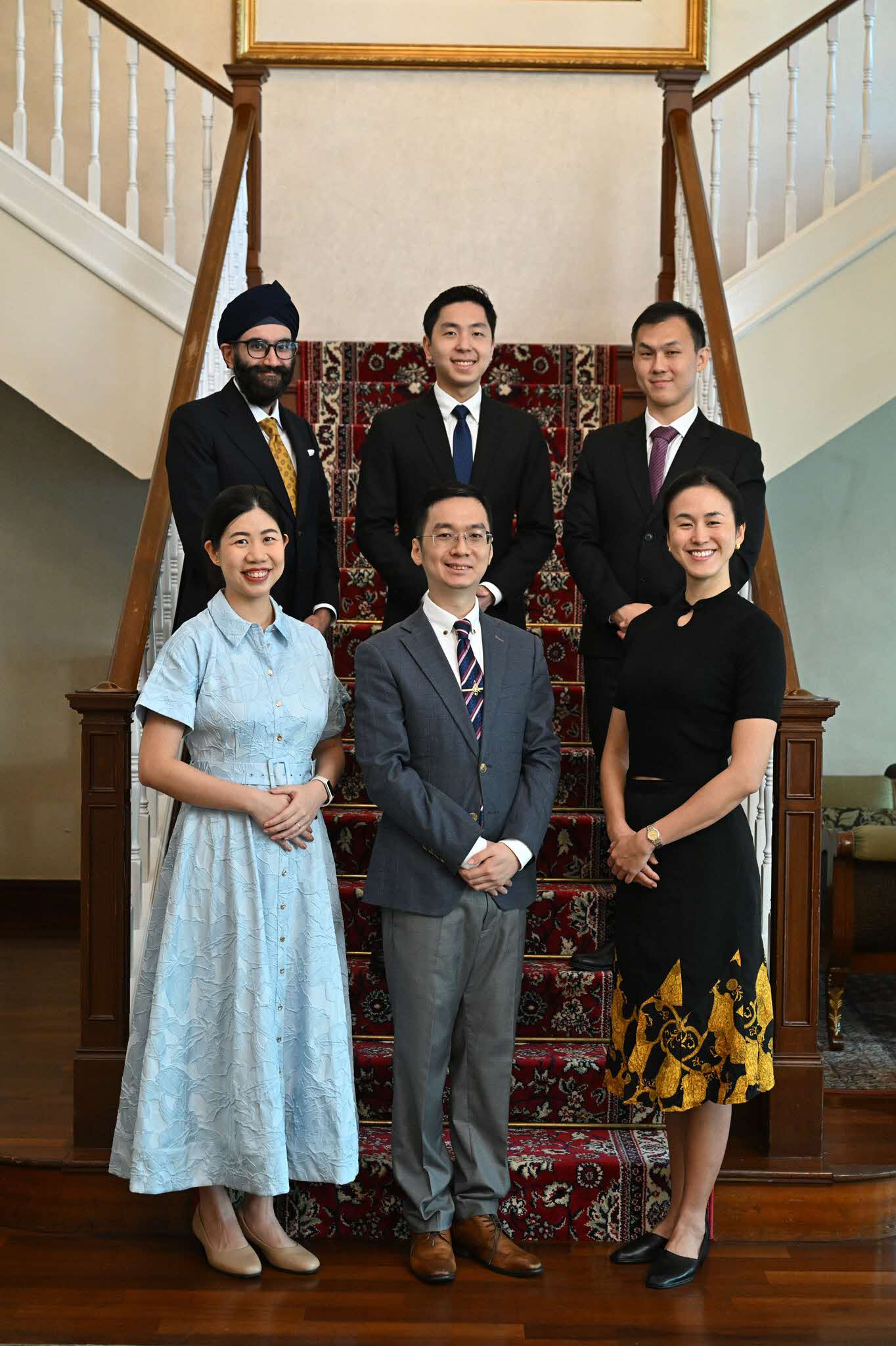
In the front row, from left: Ms Stephanie Siow Su Lyn, Mr Wang Chenwei, Ms Quah Ting Wen
In the second row, from left: Mr Navjote Singh Sachdev, Mr Chong Fu Shan, Dr Chor Wei Ping Daniel
2026 LEE KUAN YEW SCHOLARSHIP AWARD CEREMONY
Six outstanding candidates have been awarded the Lee Kuan Yew Scholarship this year for their postgraduate studies.
2. The recipients are as follows.
| S/N | Name and Age | Field of Study, University and Country |
| 1 | Mr Chong Fu Shan [钟富山] Age: 28 | LL.M (Master of Laws), Harvard University, United States of America |
| 2 | Dr Chor Wei Ping Daniel [邹炜彬] Age: 41 | Master of Science in Health Informatics, University of Illinois Chicago, United States of America |
| 3 | Mr Navjote Singh Sachdev Age: 38 | Mid-Career Master in Public Administration, Harvard University, United States of America |
| 4 | Ms Quah Ting Wen [柯婷文] Age: 33 | Master of Guidance and Counselling, James Cook University, Singapore |
| 5 | Ms Stephanie Siow Su Lyn [萧素玲] Age: 32 | Master in Business Administration, INSEAD, Singapore |
| 6 | Mr Wang Chenwei [王辰威] Age: 37 | PhD in Music Practices, National University of Singapore, Singapore |
3. The Lee Kuan Yew Scholarship was set up in 1991 by the Tanjong Pagar Citizens’ Consultative Committee in commemoration of the significant contributions made by Singapore’s founding Prime Minister. The scholarship, which receives funding support from the Lee Kuan Yew Centennial Fund, is awarded to exceptional individuals who demonstrate a strong sense of commitment to serve Singapore and Singaporeans.
4. Lee Kuan Yew Scholarship holders are fully sponsored for their tuition fees and receive an annual allowance of S$50,000 for the duration of their postgraduate studies. They may choose to pursue their postgraduate studies in any country and field of study that best develops their potential as leaders and are expected to continue contributing in their respective fields of work to benefit Singapore and society.
5. “I have been very fortunate to have had coaches, teachers, teammates, and family who have invested so much in me over the years. Receiving the Lee Kuan Yew Scholarship is a deeply humbling and encouraging opportunity for me to continue learning and equipping myself with the expertise to help build environments to enable individuals to grow, perform, and thrive. I hope to honour that trust by contributing meaningfully to the development of communities in Singapore, just as others have so generously done for me,” said Quah Ting Wen, national swimmer, three-time Olympian, and recipient of the 2026 Lee Kuan Yew Scholarship.
6. Fellow recipient Wang Chenwei, Composer-in-Residence of the Singapore Chinese Orchestra, said, “I am immensely honoured by the Lee Kuan Yew Scholarship, which entrusts me to articulate cultural identity and champion transcultural exchange through music. It empowers me to prioritise enduring impact over short-term return in my doctoral research and composition – to rediscover tradition and redefine innovation in pursuit of a genuine Singaporean sound that reflects who we are and who we aspire to be.”
7. More details on the scholarship can be found at https://www.psc.gov.sg/scholarships/postgraduate-scholarships/lee-kuan-yew-scholarship.
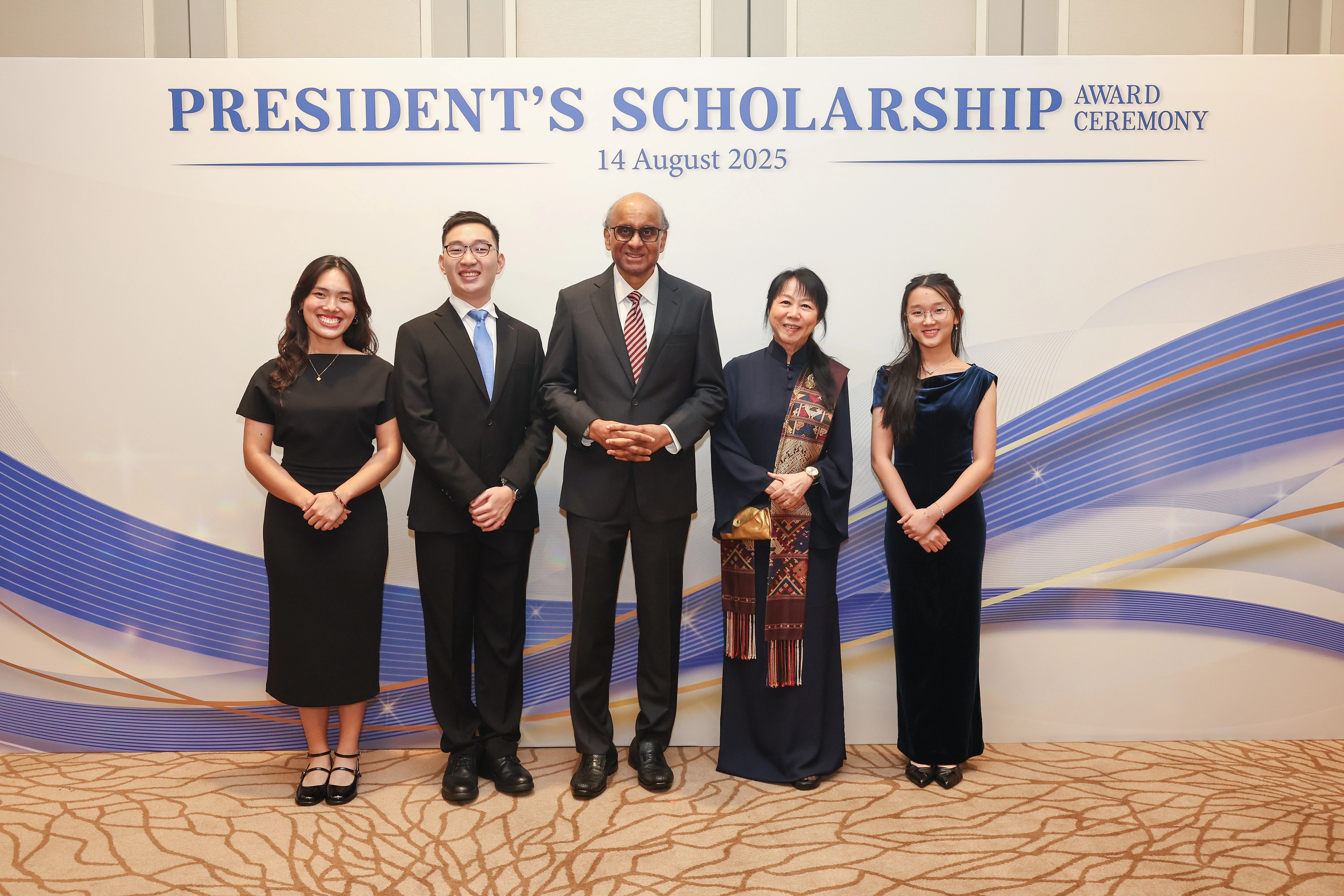
Three outstanding candidates were awarded the President’s Scholarship on 14 August 2025. They were Miss Nguyen Ngo Khiet Duyen Clarissa, Mr Kaleb Teo Tze Hsiang and Miss Hilary Chee Xin Yi.